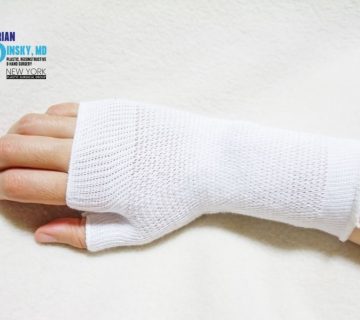

You slip on ice, fall off a bike, or catch yourself on an outstretched hand during a game. Your wrist hurts and starts to swell. Is it a sprain that will heal with rest, or a fracture that needs treatment?
The honest answer is that you often can’t tell just by looking. Broken wrists and sprains share many of the same symptoms, and some fractures are easy to miss. Here’s how to tell the difference, what to do right away, and when to see a wrist doctor on Long Island.
What’s the Difference Between a Sprain and a Broken Wrist?
A wrist sprain injures the ligaments, the tough bands of tissue that connect the bones of the wrist. A sprain can range from a mild stretch to a complete tear.
A broken wrist is a fracture of one or more wrist bones. The most common are fractures of the radius, the larger forearm bone near the thumb side, and the scaphoid, a small bone at the base of the thumb.
Both injuries often happen the same way: falling onto an outstretched hand.
Symptoms They Have in Common
Sprains and fractures can both cause:
- Pain, especially when you move your wrist
- Swelling
- Bruising
- Tenderness when you press on the area
- Weak grip
Because of this overlap, an exam and X-rays are usually the only way to know for sure.
Signs Your Wrist May Be Broken
These signs point more toward a fracture:
- Your wrist looks bent, crooked, or out of place.
- You heard or felt a snap or pop when you fell.
- Severe pain that gets worse when you grip, squeeze, or move your wrist
- Swelling that comes on quickly and keeps increasing
- Pain at the base of your thumb, especially in the small hollow on the thumb side of the wrist
- Numbness or tingling in your fingers
- You can’t move your wrist or fingers normally.
The Wrist Fracture That’s Easy to Miss
A scaphoid fracture often feels like a sprain. Swelling may be mild, and you may still be able to move your wrist. Some scaphoid fractures don’t even show up on the first X-ray.
This matters because the scaphoid has a limited blood supply, so a missed fracture can heal poorly and lead to long-term pain and arthritis. If you have pain on the thumb side of your wrist after a fall, have it checked, even if you think it’s only a sprain.
Signs it May be a Sprain
A sprain is more likely if:
- Pain and swelling are mild to moderate.
- Your wrist looks normal in shape.
- You can still move your wrist and fingers, even if it hurts.
- Symptoms start to improve within a few days of rest.
But a “sprain” isn’t always minor. A torn ligament can make the wrist unstable and cause long-term problems if you don’t treat it. If your wrist clicks, feels weak, or keeps hurting weeks later, see a wrist doctor.
When to Go to the Emergency Room
Go to the nearest emergency room or call 911 if:
- Bone is visible through the skin.
- Your wrist or hand is badly deformed.
- Your fingers are cold, pale, blue, or numb.
- You have heavy bleeding.
- The injury happened with a head, neck, or other serious injury.
What to do Right After a Wrist Injury
Until you can be seen:
- Rest your wrist and avoid using it.
- Ice it for 15 to 20 minutes at a time, with a cloth between the ice and your skin
- Elevate your wrist above your heart to help reduce swelling.
- Support it with a splint or a rolled-up magazine and a wrap, but don’t wrap too tightly.
- Remove rings, watches, and bracelets right away, before swelling makes them hard to take off.
When to See a Wrist Doctor
Make an appointment with a hand and wrist specialist if:
- You have any signs of a fracture listed above.
- You have pain on the thumb side of your wrist after a fall.
- Pain or swelling doesn’t improve after a few days.
- Your wrist clicks, catches, or feels unstable.
- You have trouble gripping, lifting, or turning a doorknob.
- You were told you had a sprain, but you’re still in pain weeks later.
Getting the right diagnosis early gives you the best chance at a full recovery. Many wrist fractures and ligament injuries heal well with the right splint or cast, and some need surgery to restore stability and motion.
How a Wrist Doctor Diagnoses Your Injury
At your visit, a hand and wrist specialist will:
- Ask how the injury happened.
- Examine your wrist for tenderness, swelling, motion, and stability.
- Check your hand’s nerves and circulation.
- Order X-rays and, if a hidden fracture or ligament injury is suspected, sometimes an MRI or CT scan.
From there, you’ll get a treatment plan, which may include a splint, a cast, hand therapy, or surgery.
See a Wrist Doctor on Long Island
Dr. Brian A. Pinsky, MD, FACS, is a board-certified plastic surgeon and a Fellow of the American College of Surgeons with fellowship training in hand and microsurgery. He diagnoses and treats wrist fractures, ligament injuries, and other hand and wrist conditions at four Long Island offices in Babylon, Garden City, Huntington Station, and Greenvale.
Our office is in network with most PPO and HMO insurance plans, and same-day care is often available for new injuries. Learn more about our Long Island wrist surgeon services or our hand specialist services.
If you’ve hurt your wrist, don’t wait to find out whether it’s broken. Call (631) 870-7208 or request an appointment online.